
His life · 1856-1943
The life of Nikola Tesla
From the parish house in Smiljan to room 3327 of the Hotel New Yorker. Nineteen chapters told from the sources: what is documented, what he told himself, and what is legend, each called by its name.
Chapter 01
1856Smiljan, Lika · 1856-1862
The house by the church
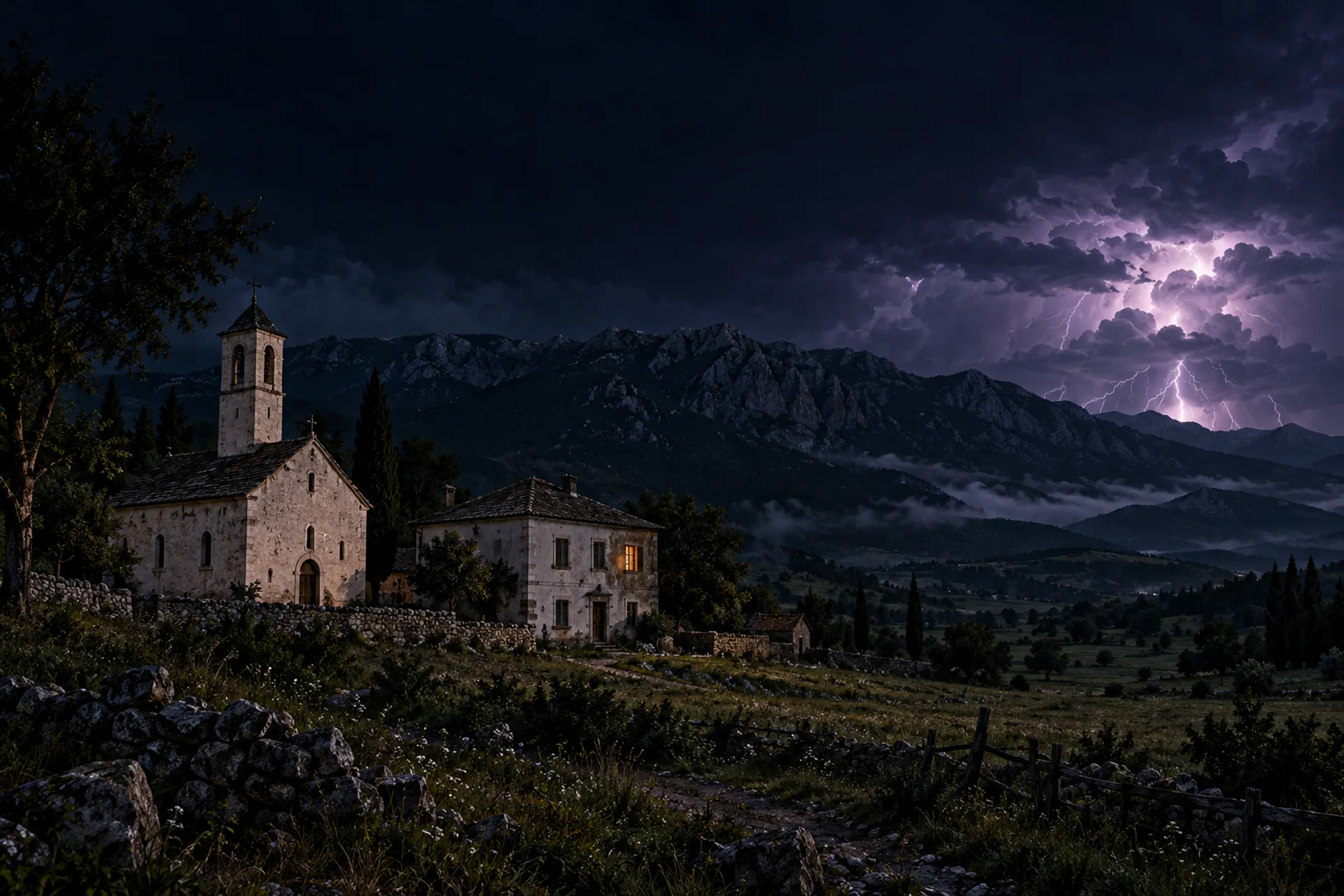
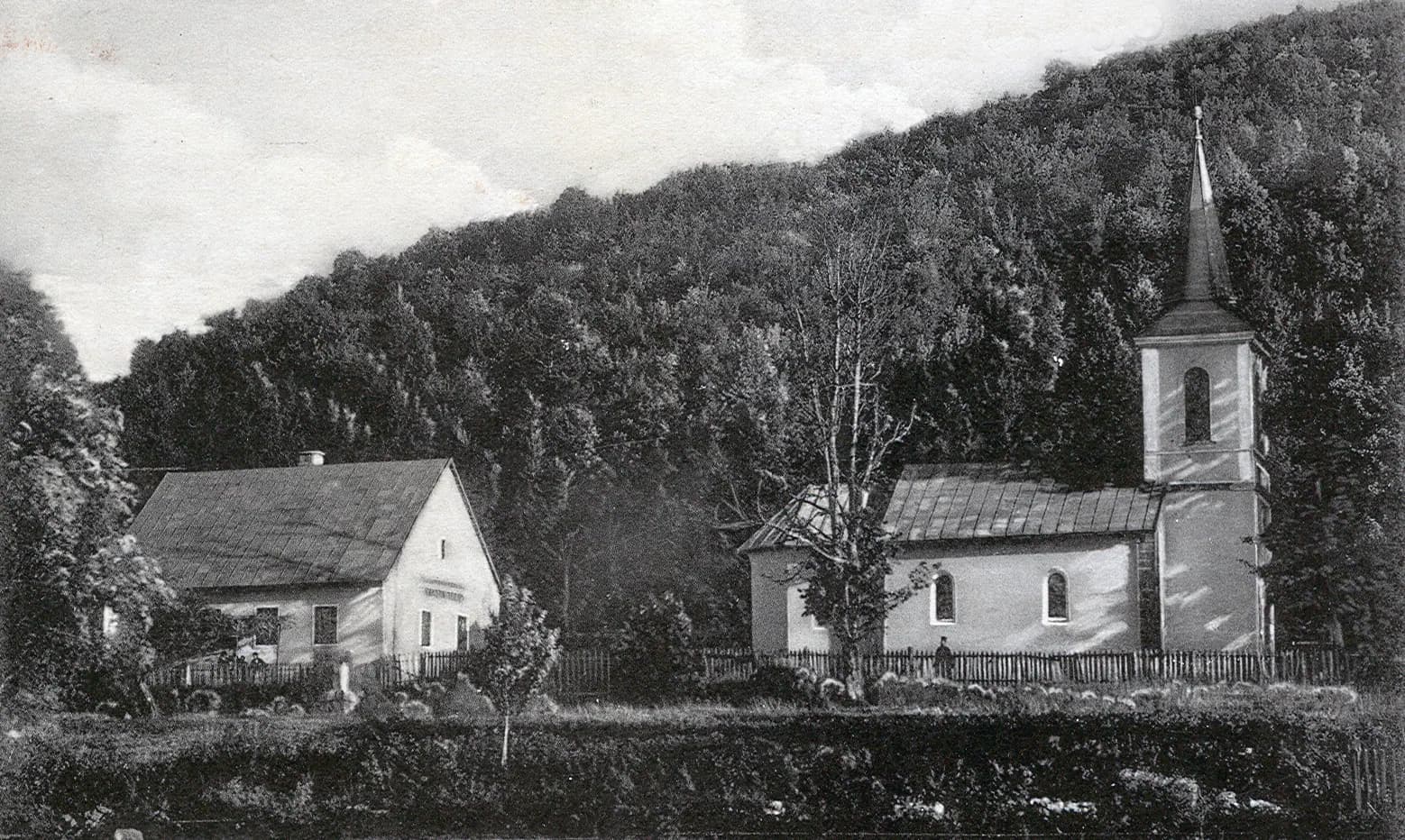
Nikola Tesla was born on 10 July 1856 in Smiljan, a village in the Lika region, then part of the Austrian Empire's Military Frontier and now in Croatia. By the Julian calendar of the Orthodox Church it was 28 June. He was born in the parish house, next to the Church of Saints Peter and Paul, where he was baptised.
His father, Milutin, was a Serbian Orthodox priest. His mother, Đuka Mandić, herself a priest's daughter, invented tools for the household, and Tesla credited her with his gift for invention. His older brother, Dane, died young in a riding accident; he also had three sisters, Angelina, Milka and Marica.
Born to a Serbian family in what is now Croatia, he is remembered by both countries as their own.
Chapter 02
1862Gospić · 1862-1870
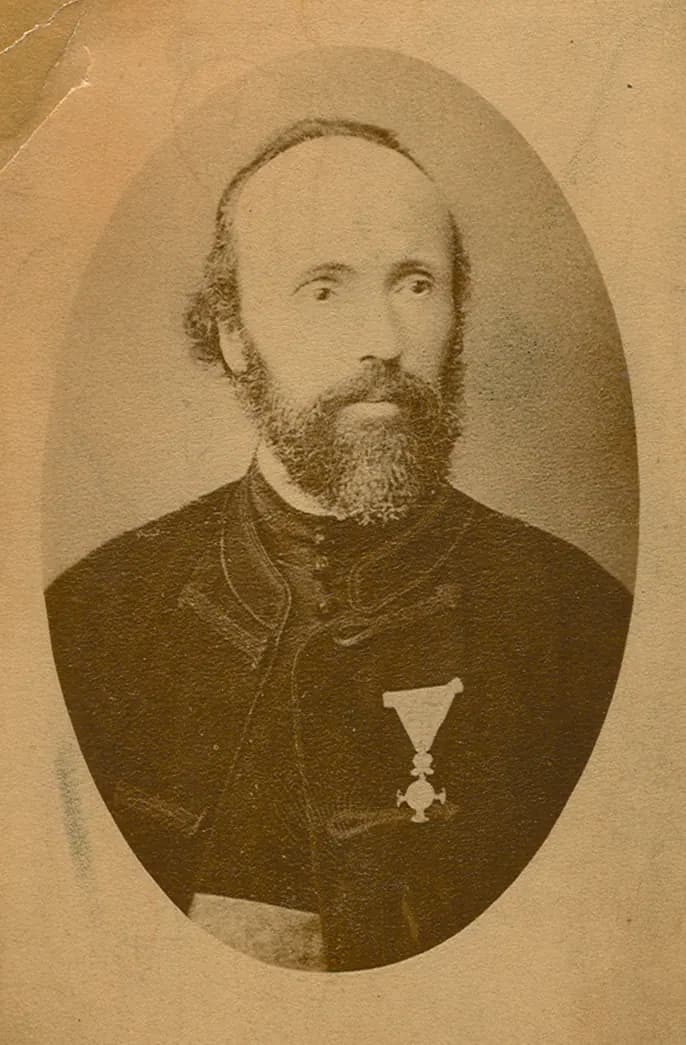
The Gospić years
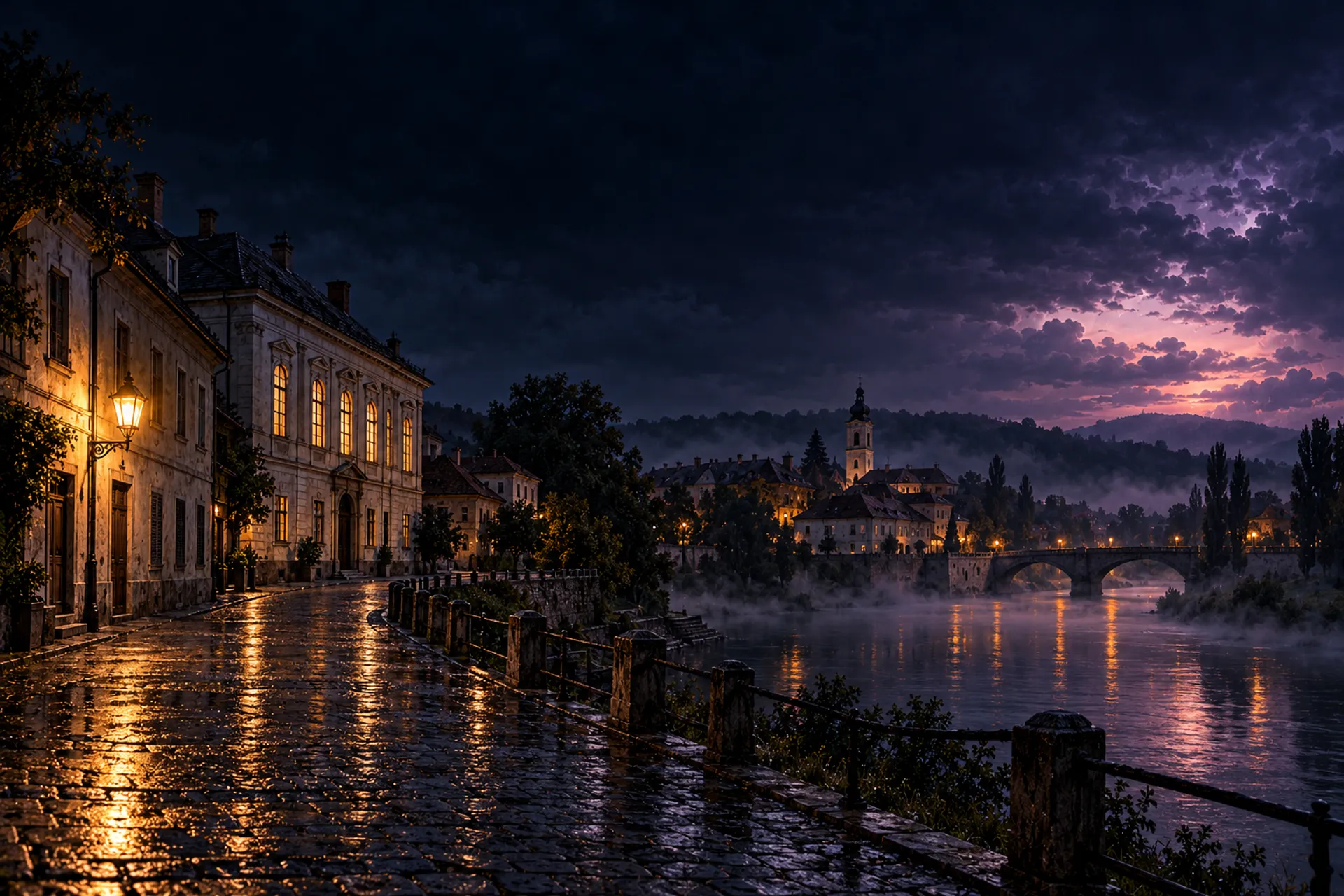
In 1862 Milutin Tesla was posted to the parish of Gospić, the main town of Lika, and the family moved with him. There Nikola went to primary school and then to the lower real school.
Gospić keeps coming back in this story: he returned there ill in 1873, his father died there in 1879 and his mother in 1892. Today the town has his statue, by Frano Kršinić.
Chapter 03
1870Karlovac · 1870-1874
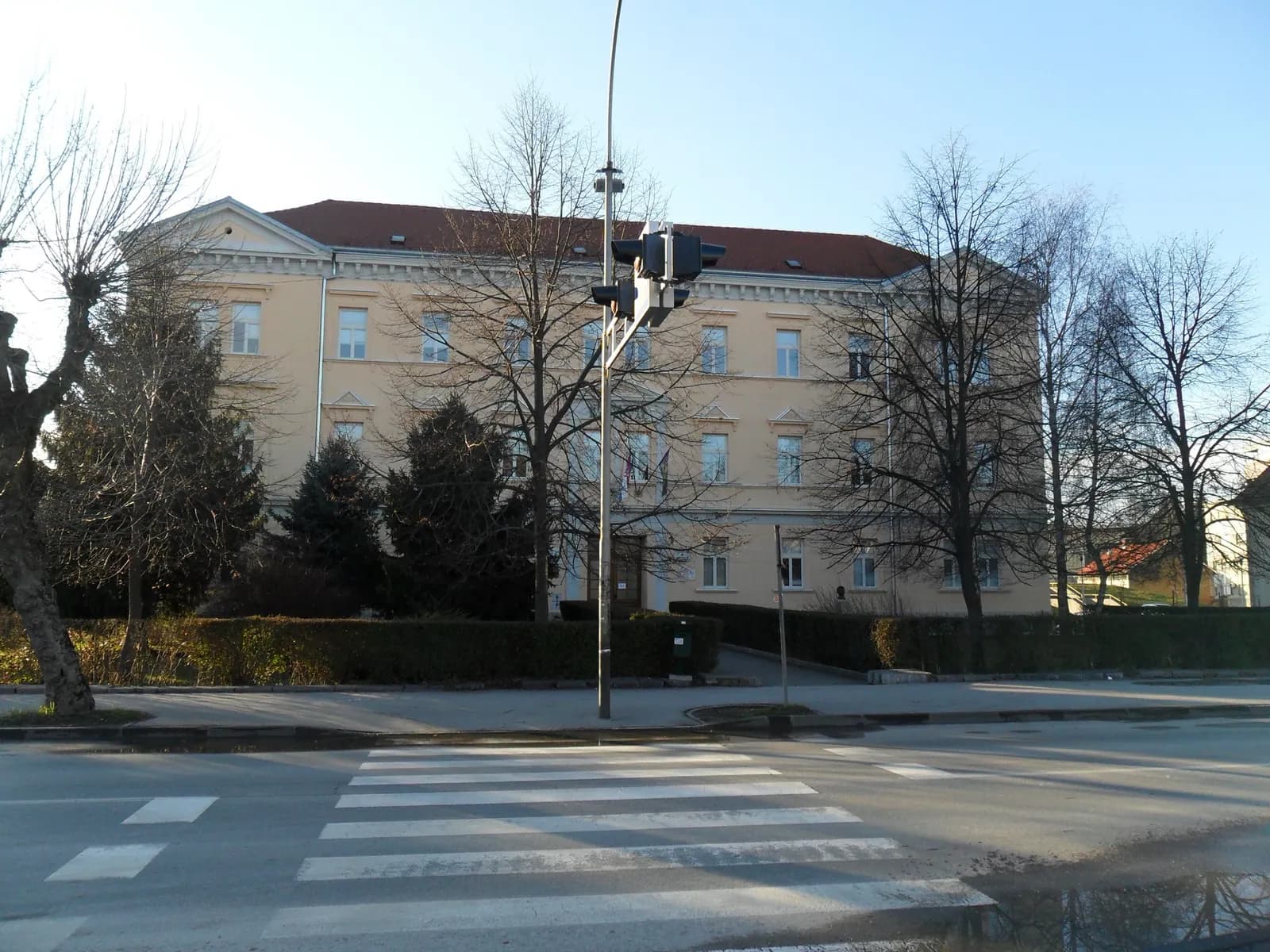
A calling in Karlovac
He attended the Higher Real Gymnasium in Karlovac, in the Rakovac district, living with his aunt Stanka, and finished in three years instead of four, in 1873. By his own account, Professor Martin Sekulić's physics demonstrations were what drew him to electricity.
Back in Gospić he caught cholera and spent some nine months in bed. As he told it, that was when his father, who had wanted him in the priesthood, promised to send him to study engineering instead. In 1874, to avoid military service, he hid for almost a year in the mountains near Gračac.
Chapter 04
1875Graz · 1875-1878
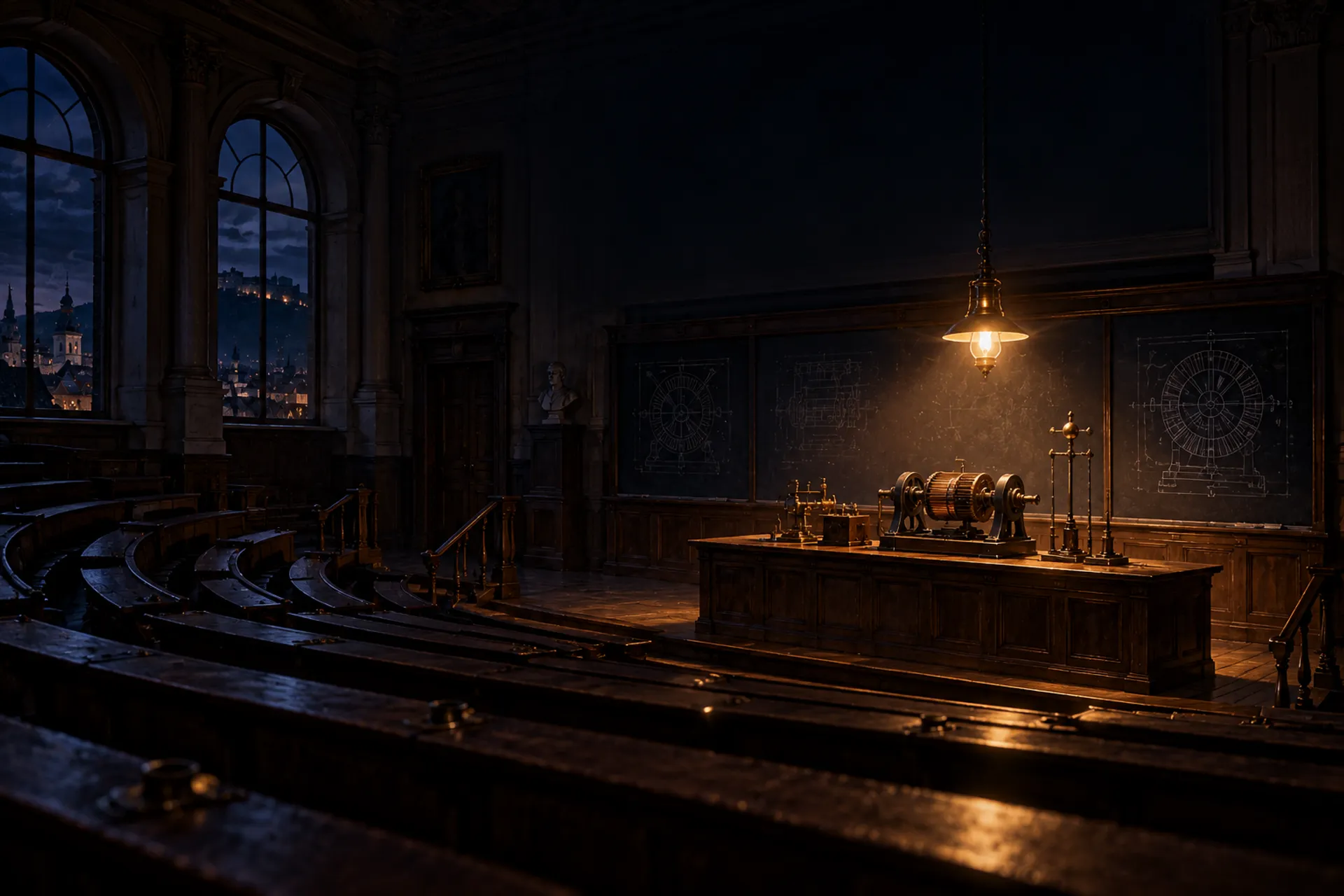
The motor that couldn't exist
In 1875 he entered the Technical College in Graz, today TU Graz, on a Military Frontier scholarship. His first year was outstanding.
There he watched Professor Jacob Pöschl run a Gramme dynamo as a motor, sparking at the commutator, and told him the commutator could be done away with. The professor answered that it was like chasing perpetual motion. The idea stayed with him for years.
Then he lost the scholarship, took to gambling, and in December 1878 left Graz without a degree.
Chapter 05
1878Maribor and Prague · 1878-1880
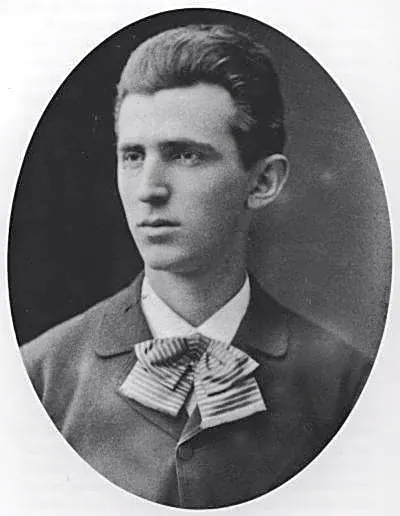
Between Maribor and Prague
In late 1878 he worked as a draughtsman in Maribor, in today's Slovenia. On 17 April 1879 his father died in Gospić.
In January 1880 he went to Prague and audited the summer semester at the Charles-Ferdinand University. No grades of his are on record, and he left before it ended.
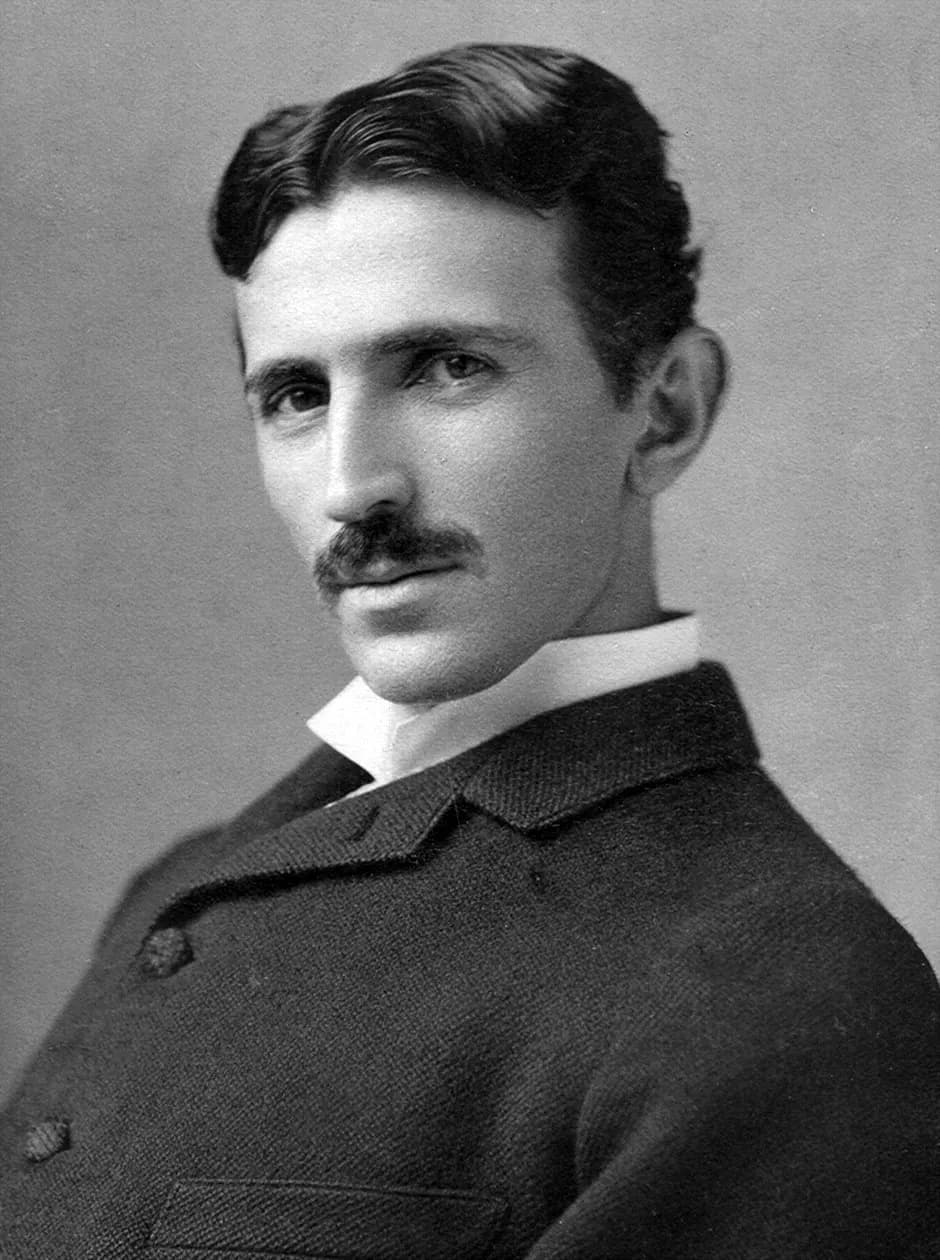
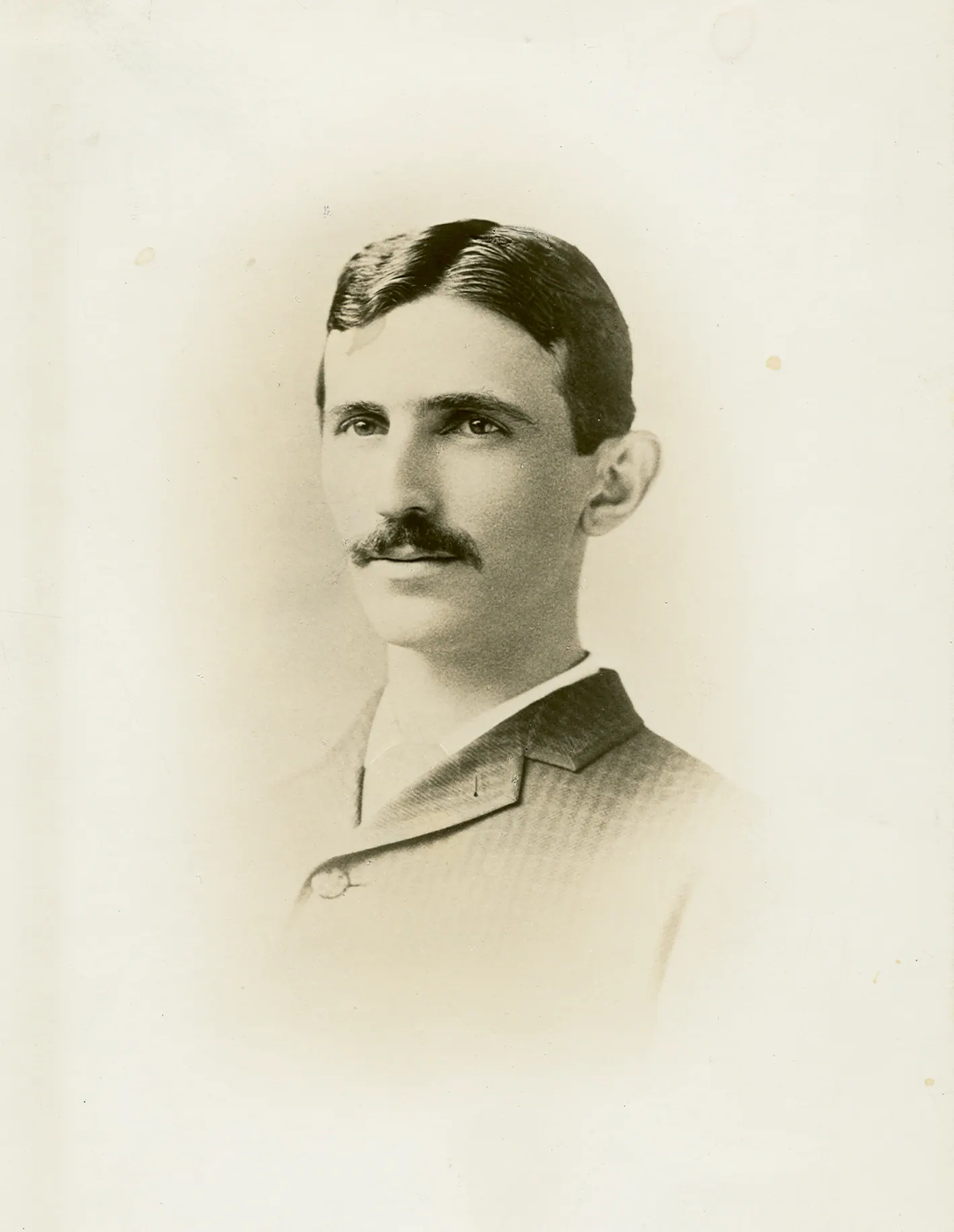
The photograph here is the earliest known of him. He is 23.
Chapter 06
1882Budapest · 1881-1882
The idea in the park
In January 1881 he arrived in Budapest to work at Tivadar Puskás's telephone exchange, where he rose to chief electrician.
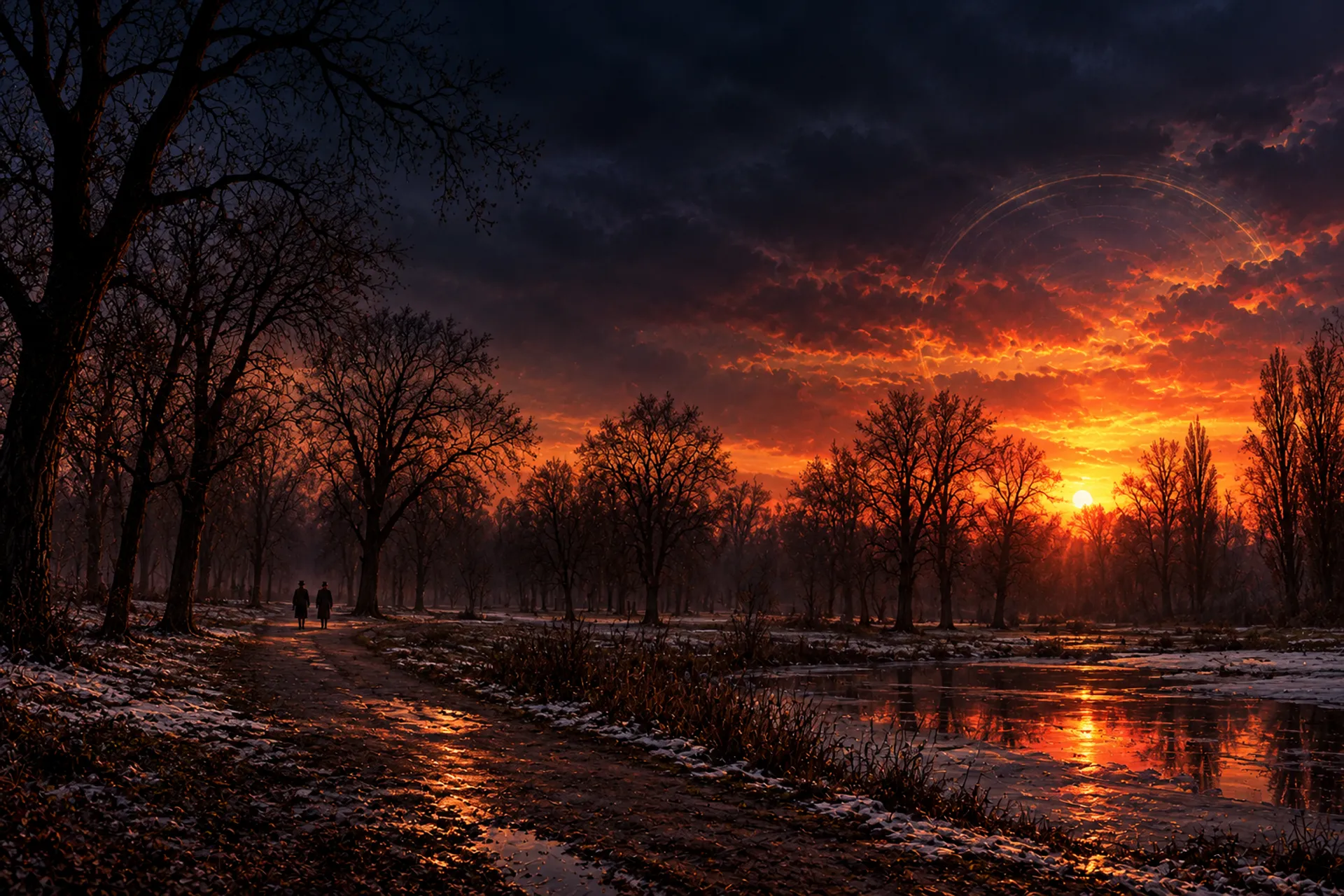
One evening in February 1882, by his own account, he was walking through the City Park with his friend Antal Szigeti, reciting Goethe's Faust as the sun went down. In that moment he saw the whole principle of the rotating magnetic field, and drew the diagram in the sand with a stick.
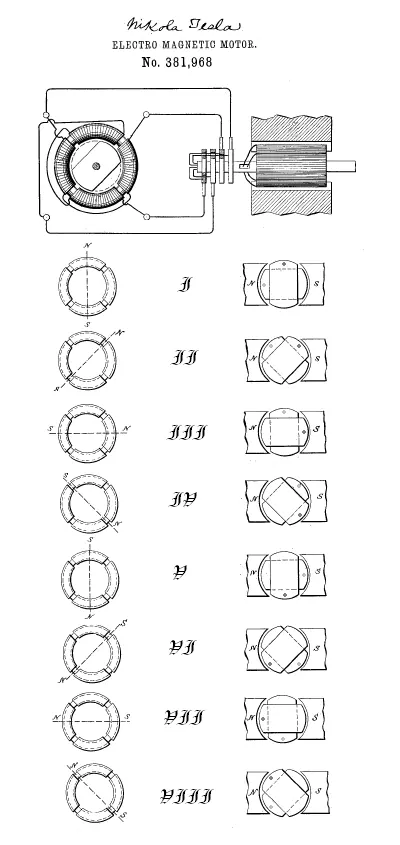
It is the principle behind the polyphase AC induction motor.
“The glow retreats, done is the day of toil; / It yonder hastes, new fields of life exploring…”
Chapter 07
1883Paris and Strasbourg · 1882-1884
The first motor turns
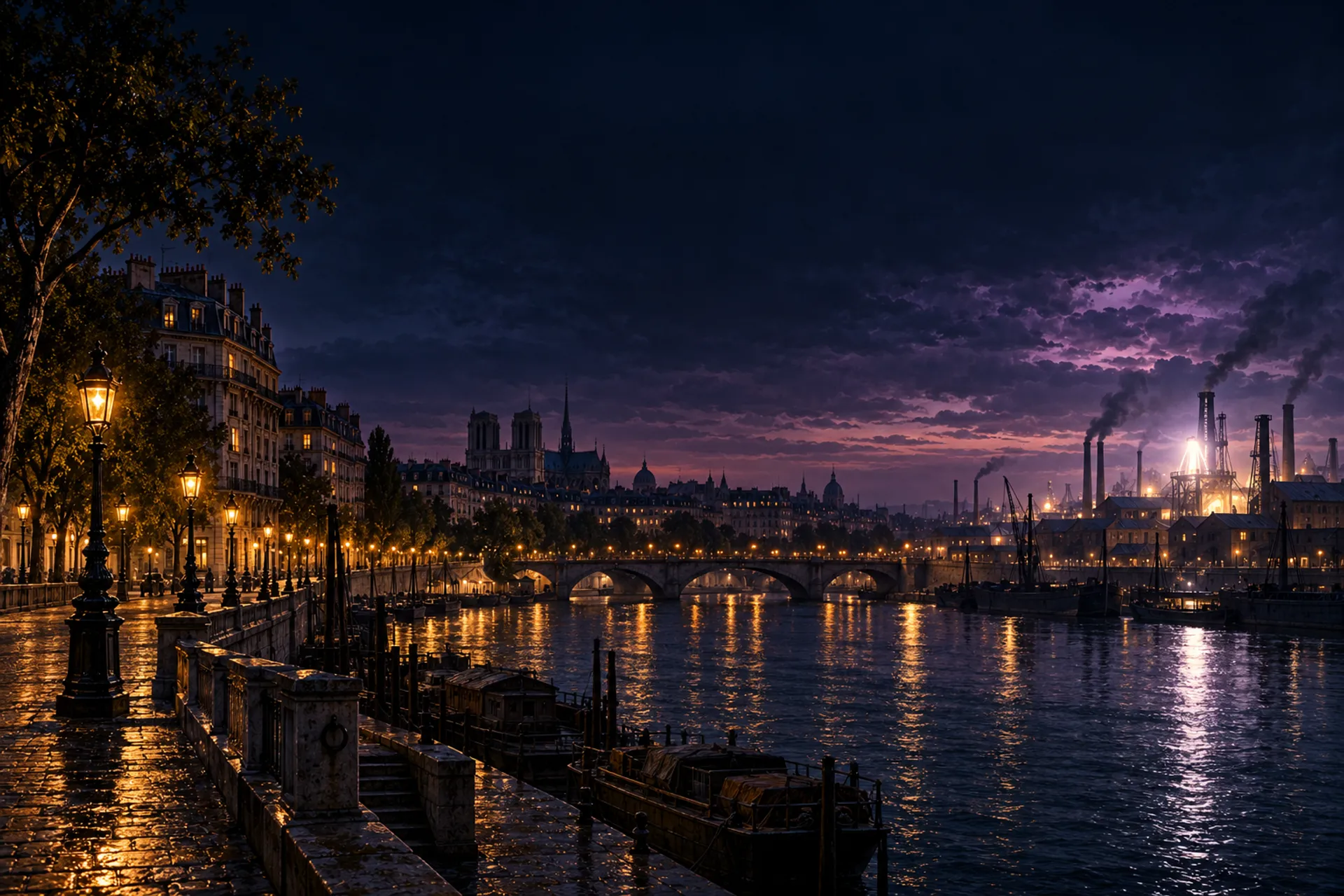
In autumn 1882 he joined the Compagnie Continentale Edison, which built Edison's dynamos and lamps for Europe, and worked at its shops in Ivry-sur-Seine, just outside Paris.
In 1883 the company sent him to Strasbourg, then part of Germany, to fix the railway station's electrical plant, which had failed at its opening. There, in his spare hours, he built the first prototype of his induction motor. It worked.
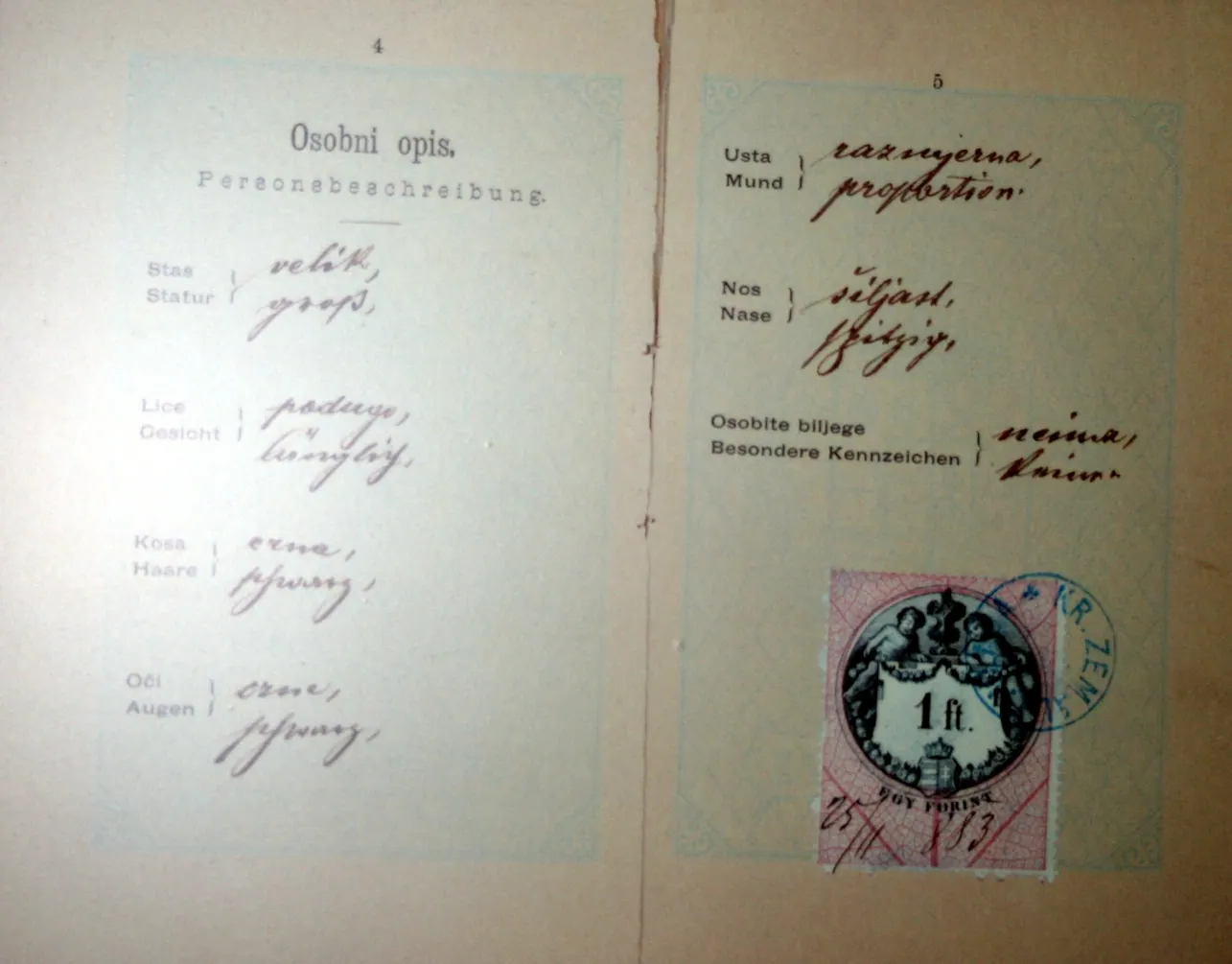
His passport dates from the same year: issued on 25 November 1883 by the land government of Croatia-Slavonia-Dalmatia.
Chapter 08
1884New York and Rahway · 1884-1887
A letter for Edison
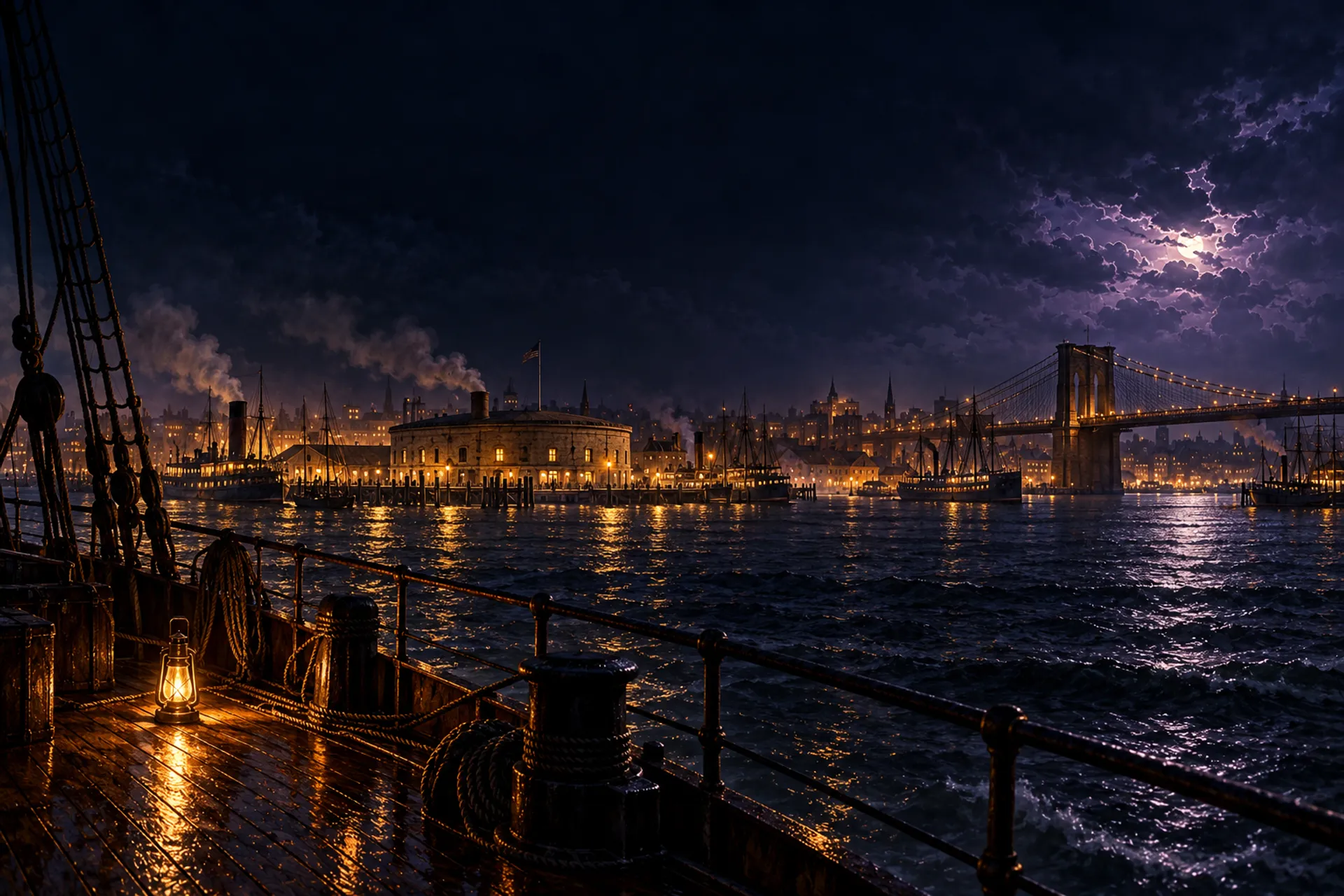
On 6 June 1884 he landed in New York through Castle Garden, carrying a letter of introduction from Charles Batchelor to Thomas Edison. He joined the Edison Machine Works on Goerck Street, redesigning dynamos, and quit in early 1885.
In March 1885 he set up an arc-lighting company in Rahway, New Jersey, with two partners, Benjamin Vail and Robert Lane. His first patents, from 1886, are for arc lamps. The partners pushed him out: he kept the patents but not the shares that mattered. By his own account, in 1886 and 1887 he worked as a labourer, digging ditches.
Chapter 09
1888New York and Pittsburgh · 1887-1889
Alternating current
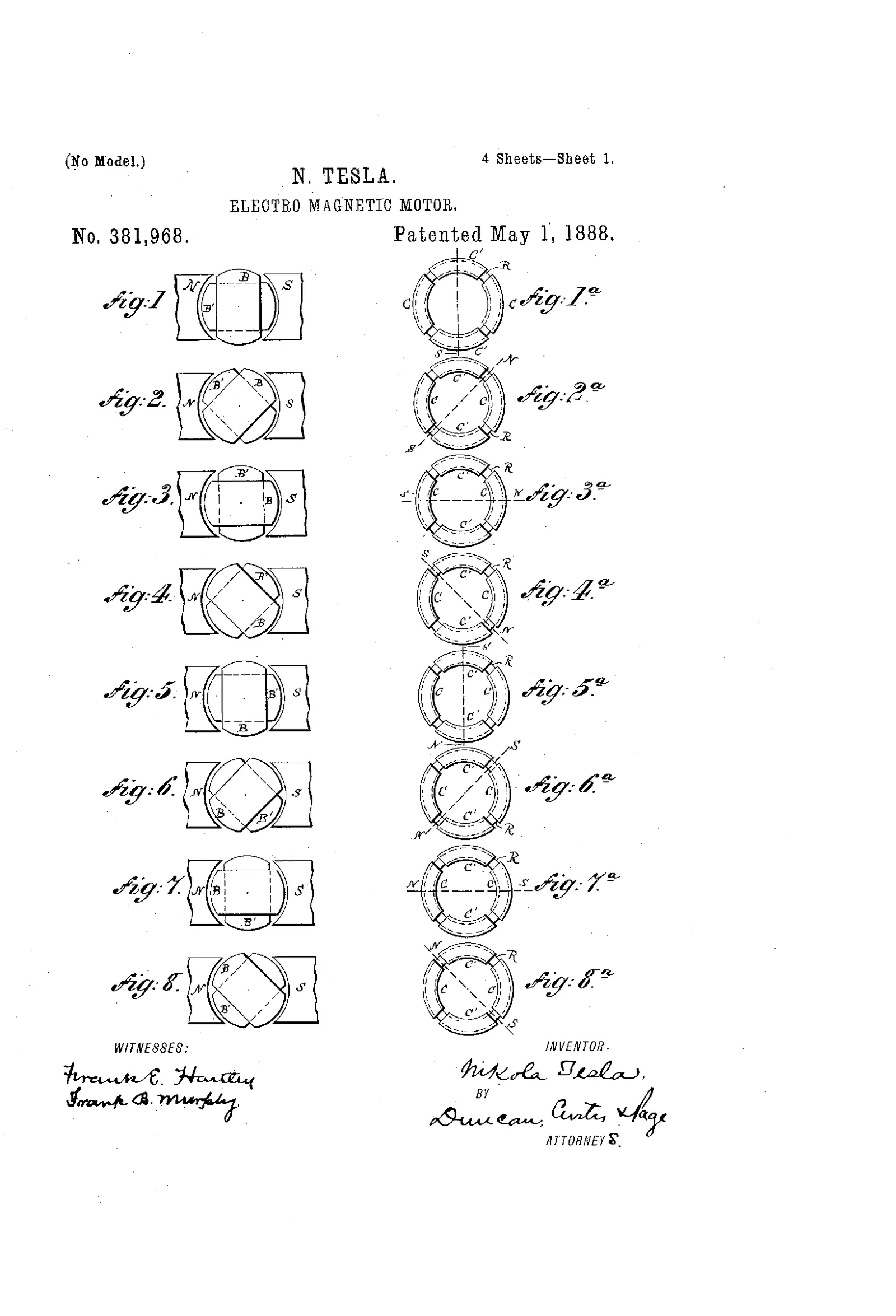
In April 1887, with Alfred S. Brown and Charles F. Peck, he founded the Tesla Electric Company, with a laboratory at 89 Liberty Street in Manhattan. On 12 October he filed the patent for the rotating-field induction motor: US 381,968, granted on 1 May 1888. Two weeks later he presented it to the American Institute of Electrical Engineers.
In July 1888 George Westinghouse licensed his polyphase patents; according to his biographer W. Bernard Carlson, for $60,000 in cash and stock plus a royalty of $2.50 per horsepower. Tesla spent about a year in Pittsburgh as a consultant.
This was the War of the Currents: Edison's direct current against Westinghouse's alternating current. The campaign against AC went as far as the electric chair, first used in 1890. Tesla did not run that commercial fight. He had invented the system.
“I do not think there is any thrill that can go through the human heart like that felt by the inventor as he sees some creation of the brain unfolding to success. Such emotions make a man forget food, sleep, friends, love, everything.”
Chapter 10
1891New York and Zagreb · 1889-1895
Light without wires
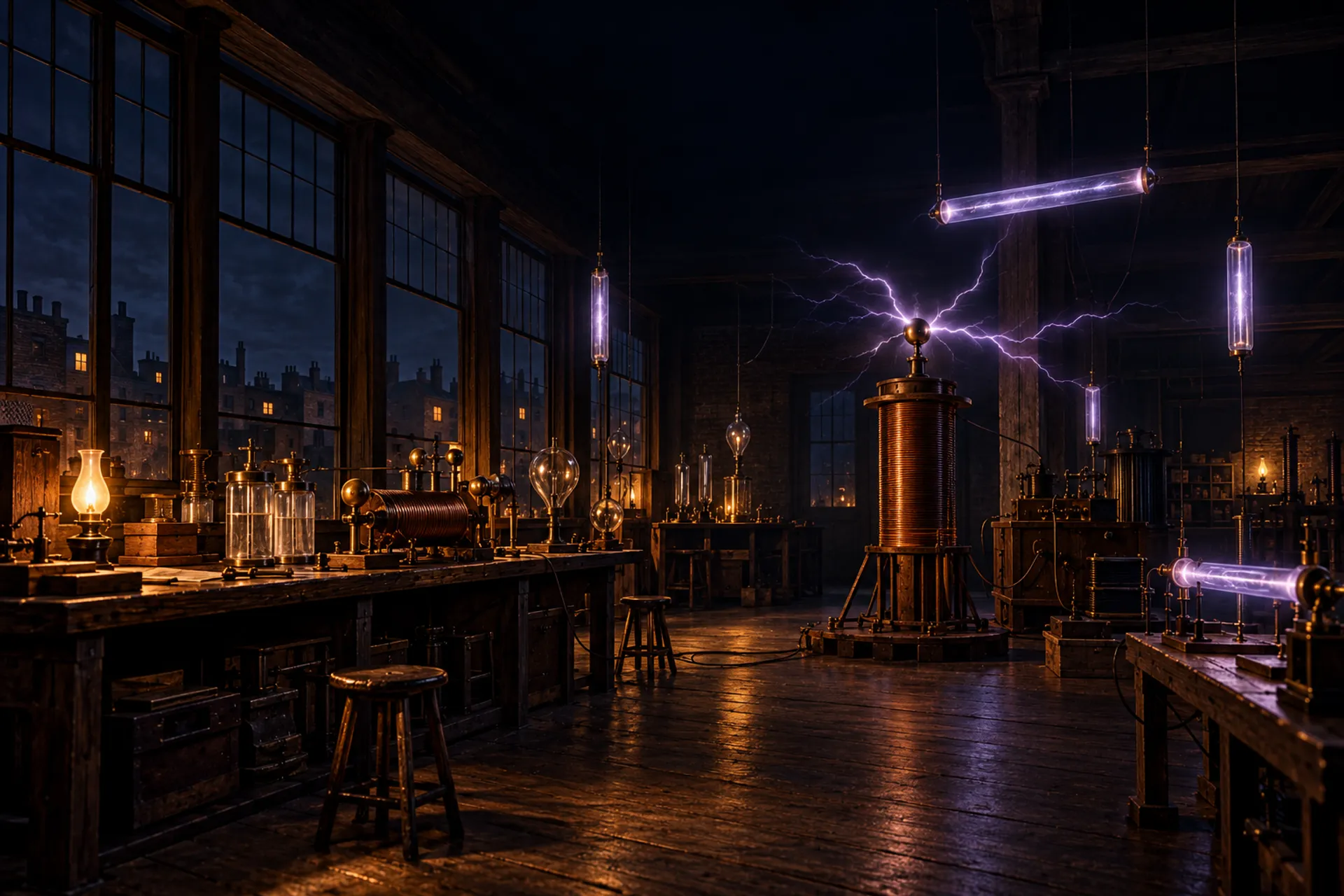
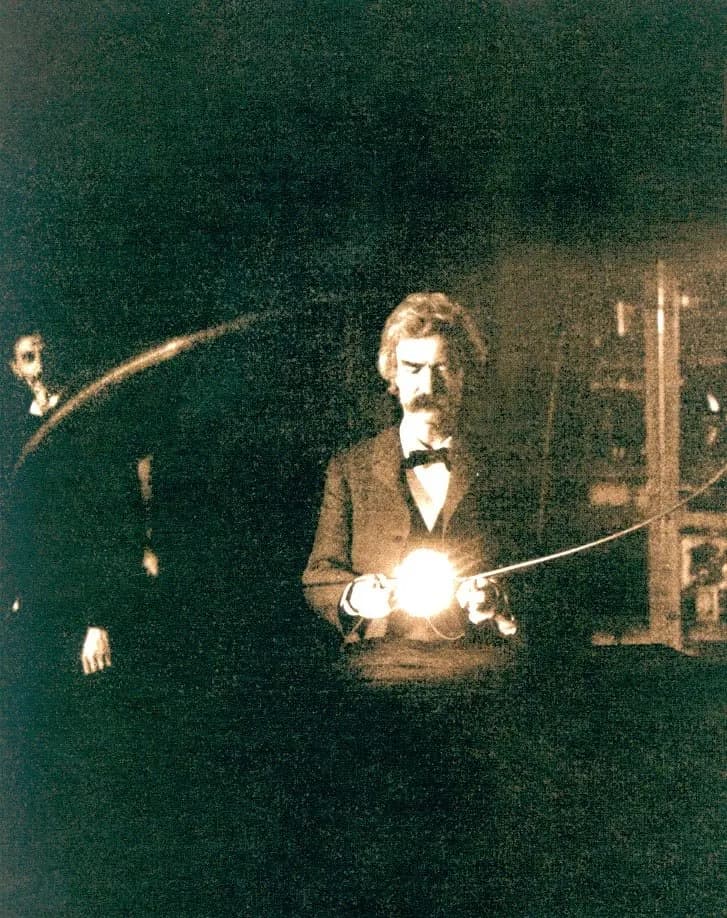
From 1889 to 1895 his laboratory was at 33-35 South Fifth Avenue, Manhattan. There he ran his high-frequency experiments: gas-discharge tubes that anticipate neon, and lamps that lit up with no wires at all, in the field of his coil. On 30 July 1891 he became an American citizen, and that year he patented the Tesla coil, the resonant transformer that bears his name.
He lectured at Columbia in 1891, and in London and Paris in 1892. In April 1892 his mother died in Gospić. A month later, on 24 May, he was in Zagreb, proposing to the city council, in the old town hall on St. Mark's Square, that the city build an alternating-current power station. It wasn't built then; today a plaque marks the visit.
In spring 1894 Mark Twain posed in the laboratory holding one of those lamps. That is the photograph on this page.
Chapter 11
1893Chicago · 1893
Chicago lights up
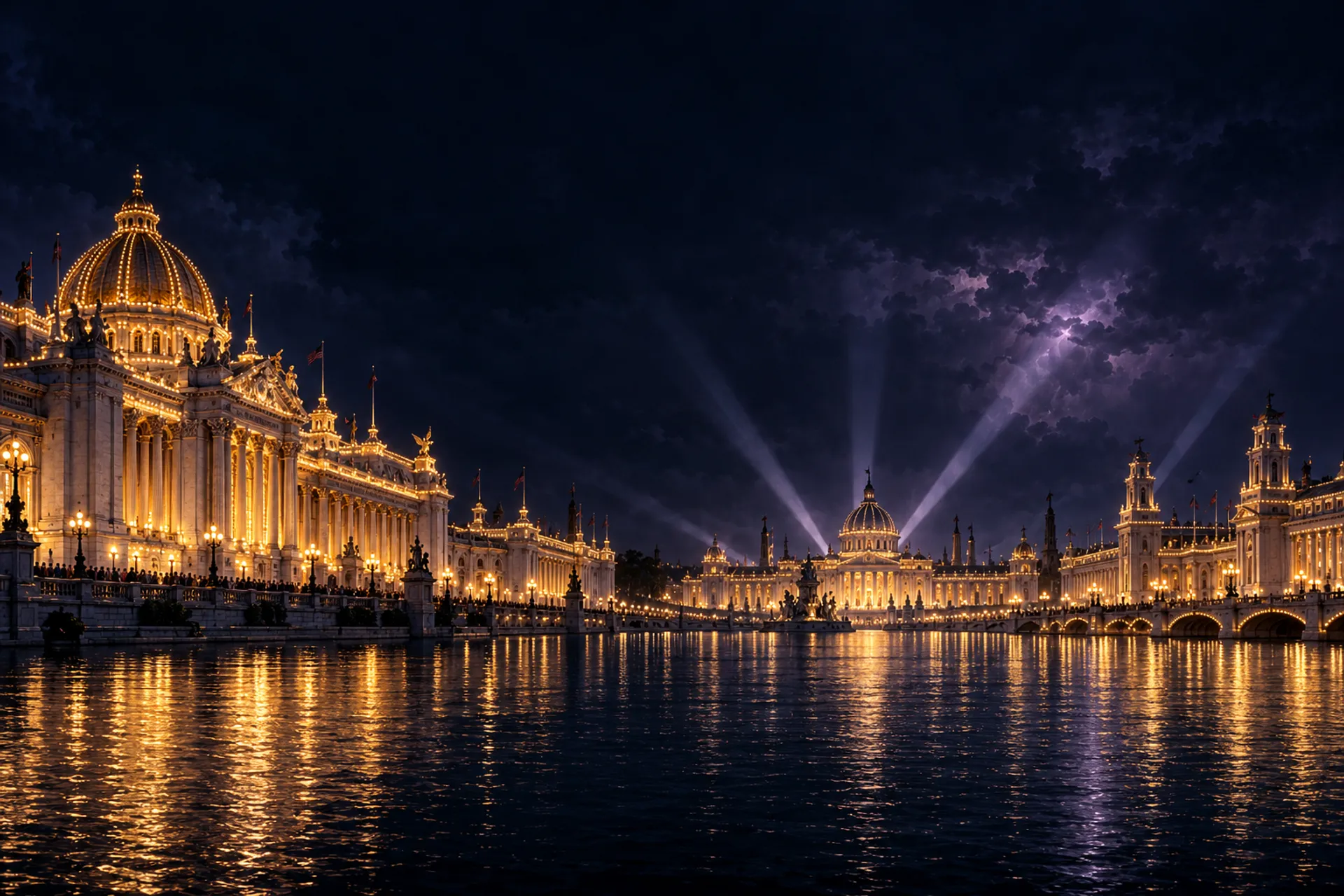
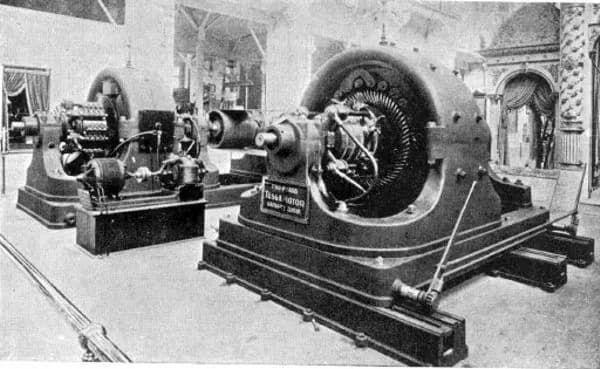
The World's Columbian Exposition opened in Chicago on 1 May 1893 and closed on 30 October. Westinghouse won the contract to light it with alternating current, and its pavilion showed Tesla's polyphase system, including a 500-horsepower generator.
Tesla showed his discharge tubes and the Egg of Columbus, a copper egg that spun in the rotating field, and in August he spoke at the International Electrical Congress.
Chapter 12
1895Niagara Falls · 1895-1896
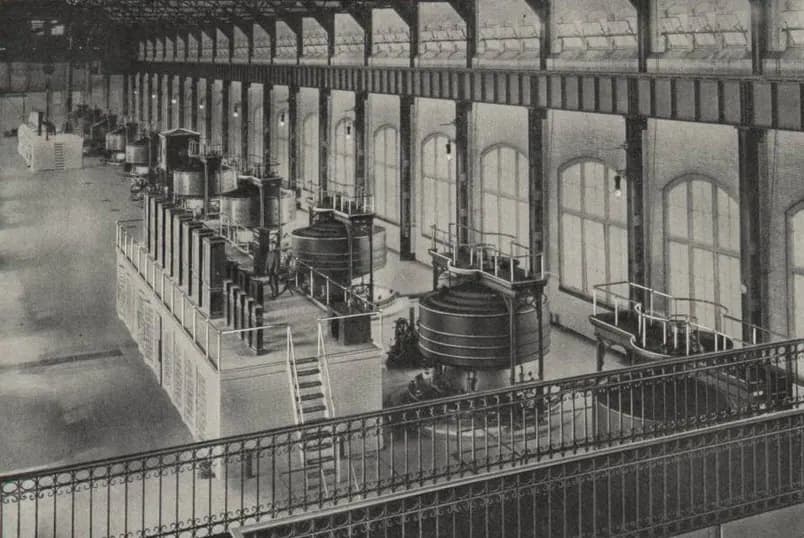
The power of Niagara
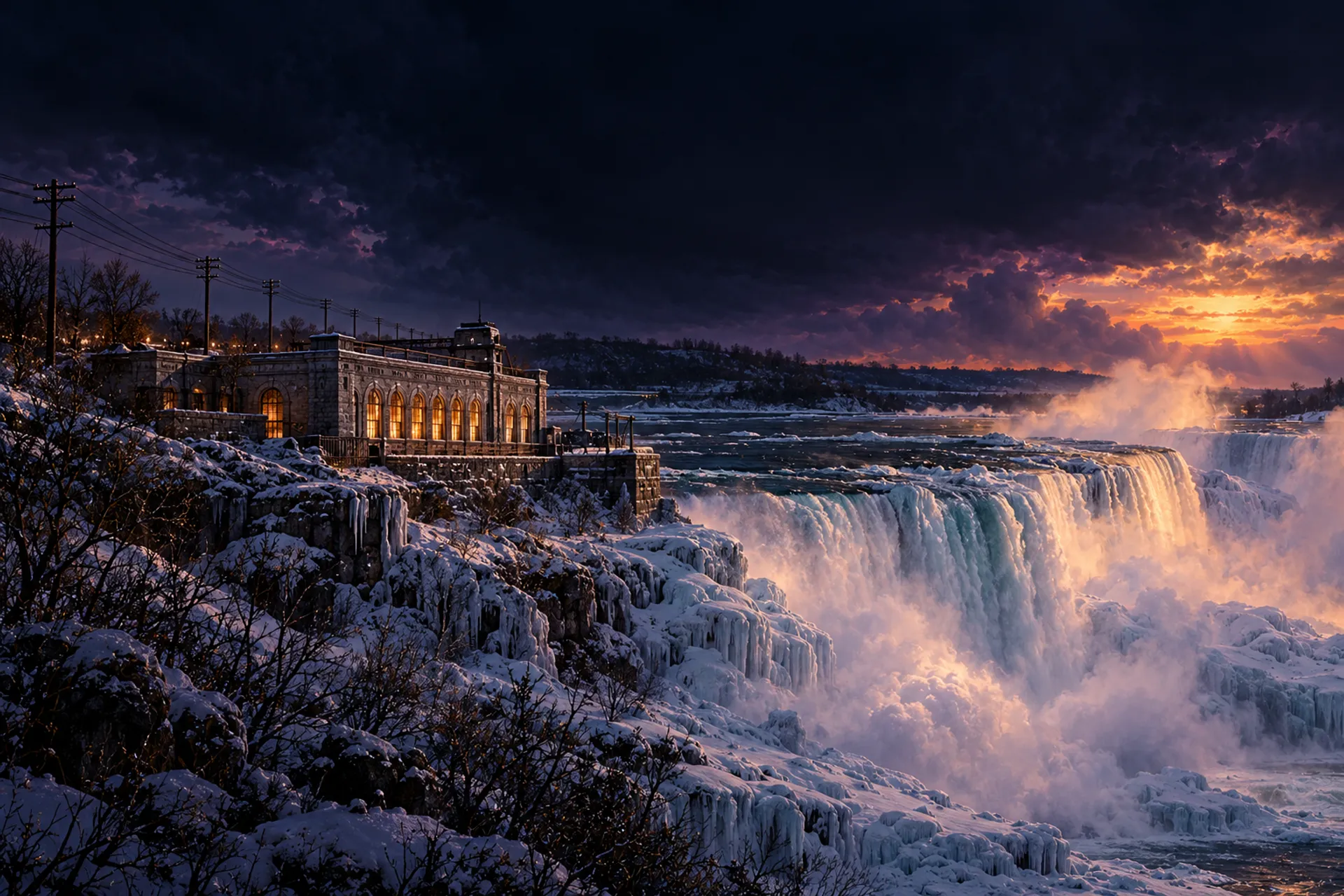
In 1893 the Cataract Construction Company chose Westinghouse's polyphase system, built on Tesla's patents, for Niagara Falls. The Edward Dean Adams Power Plant started up in August 1895 with 5,000-horsepower generators: the first large alternating-current power station.
On 16 November 1896 its current reached Buffalo, some 40 kilometres away. It was the proof that alternating current could carry power over distance.
Chapter 13
1895New York · 1895-1898
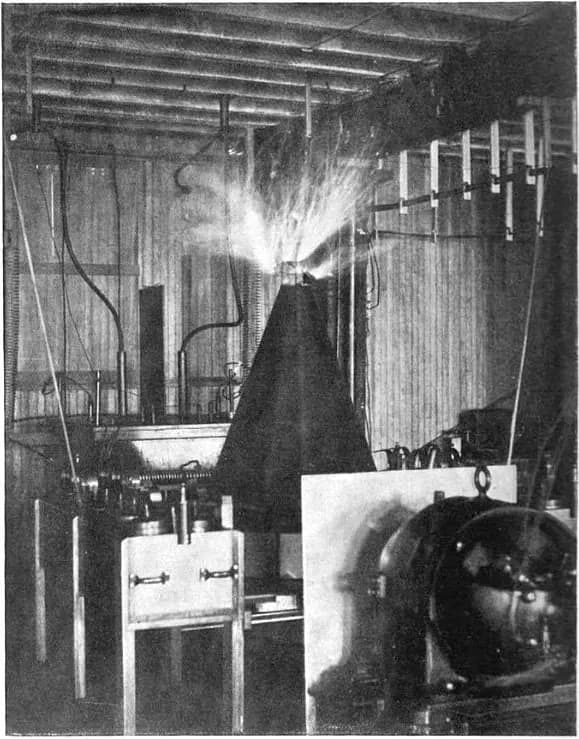
The fire
In the early hours of 13 March 1895 the South Fifth Avenue building caught fire. Tesla lost the entire laboratory: machines, notes, prototypes. He had no insurance.
He started again at 46 East Houston Street. In 1898, at the Electrical Exhibition in Madison Square Garden, he showed a boat that took its orders by radio, which he called a teleautomaton. Its patent, US 613,809, was granted on 8 November that year.
Chapter 14
1899Colorado Springs · 1899-1900
Lightning in Colorado
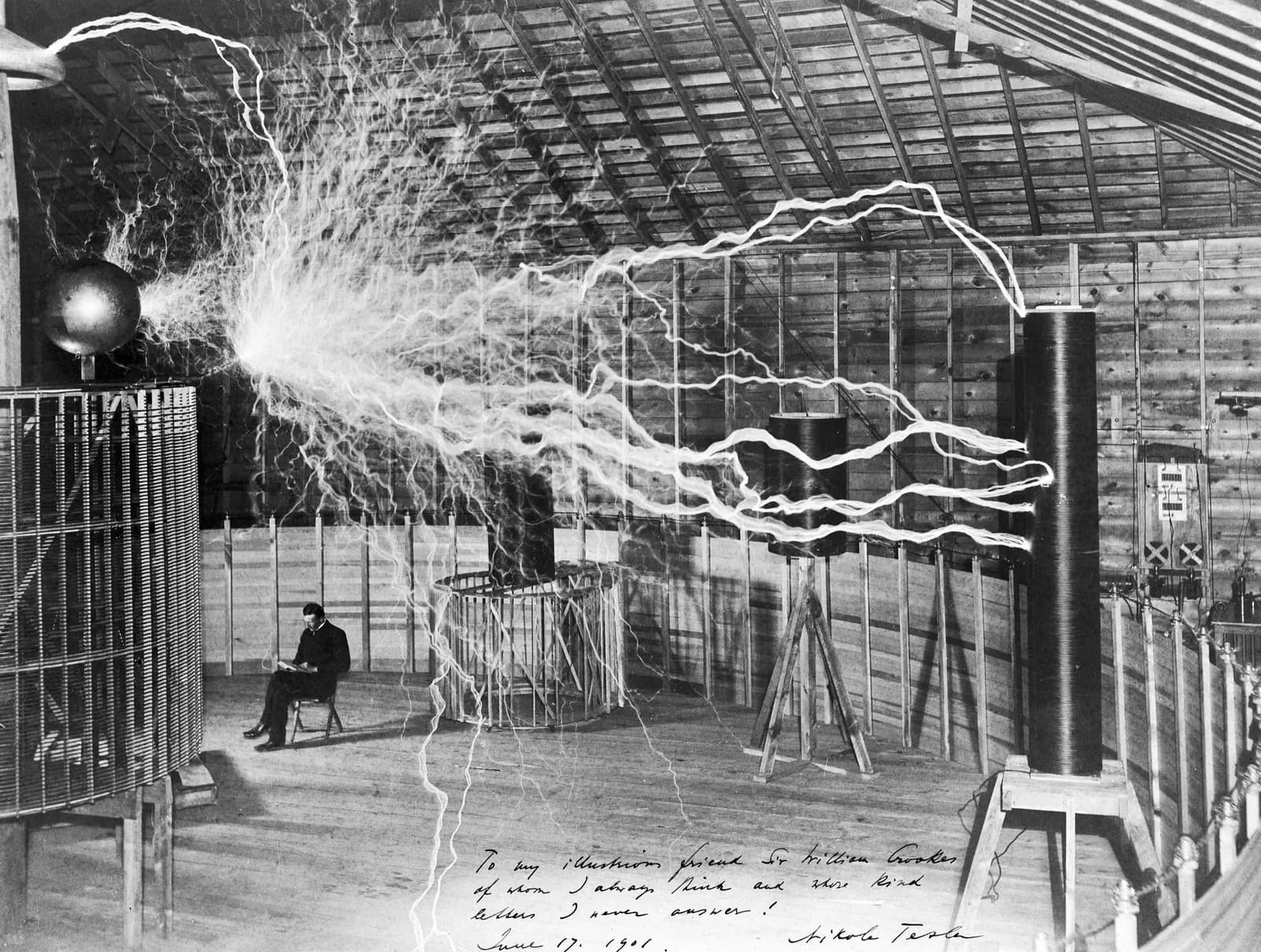
In May 1899 he arrived in Colorado Springs and built a laboratory around a giant magnifying transmitter to study lightning storms and wireless power transmission. He left in January 1900. His notes from those months were published in 1978.
The most famous photograph of that time shows him calmly reading beside discharges several metres long. It is a multiple exposure, made by the photographer Dickenson V. Alley in December 1899: Tesla was not sitting there while the machine fired. It ran in Century Magazine in June 1900, alongside his essay on human energy.
“Of all the frictional resistances, the one that most retards human movement is ignorance…”
Chapter 15
1901Shoreham, Long Island · 1901-1917
The Wardenclyffe tower
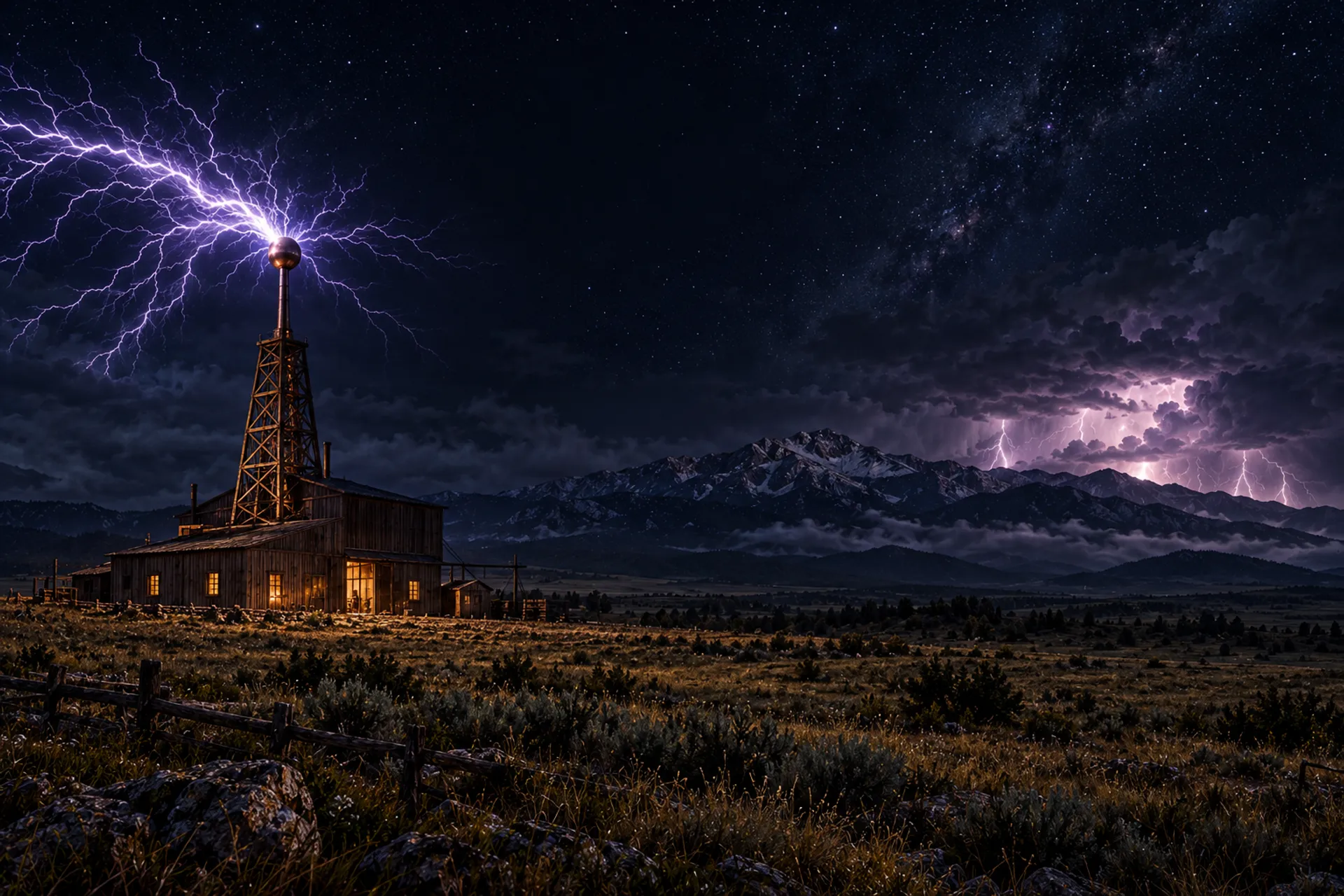
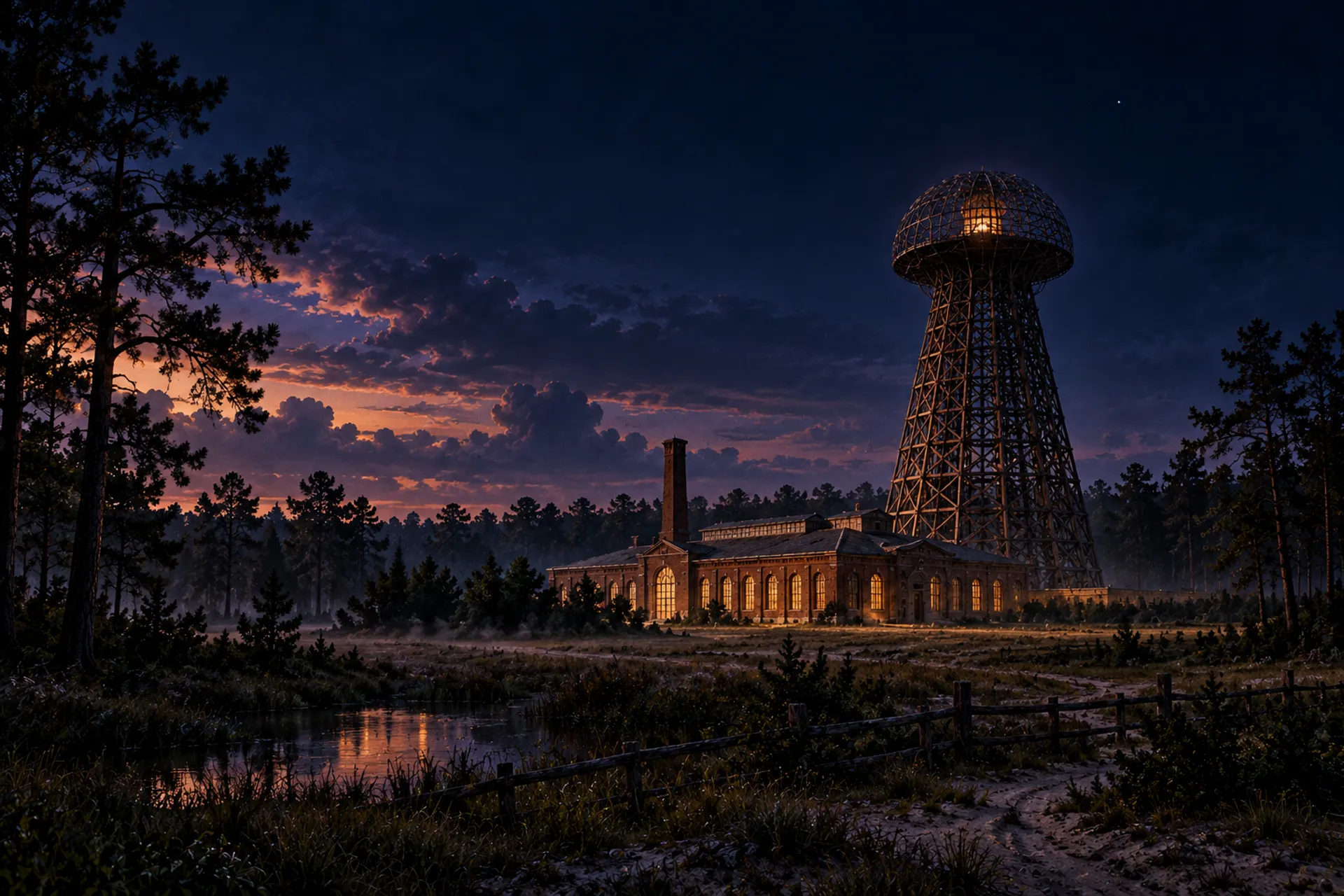
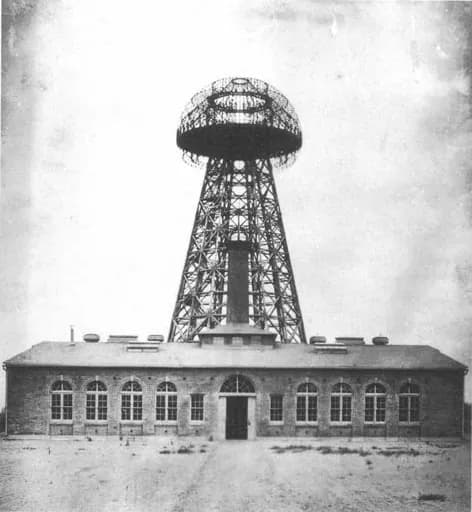
In 1901 J. P. Morgan put up $150,000 for a wireless telegraphy and world transmission station at Shoreham, Long Island. Stanford White's firm designed the plant, and the tower rose to 57 metres.
In December 1901 Marconi sent a signal across the Atlantic, and Morgan put in nothing more. Work stalled around 1904 or 1905. Meanwhile Tesla patented a bladeless turbine of smooth discs (1913) that never found a market. In 1917 the tower was torn down and sold for scrap to pay what he owed the Waldorf-Astoria. That same year the AIEE gave him the Edison Medal, its highest honour.
Today the site is the Tesla Science Center at Wardenclyffe, bought in 2013 through a crowdfunding campaign.
Chapter 16
1934Hotel New Yorker, New York · 1934-1943
Room 3327
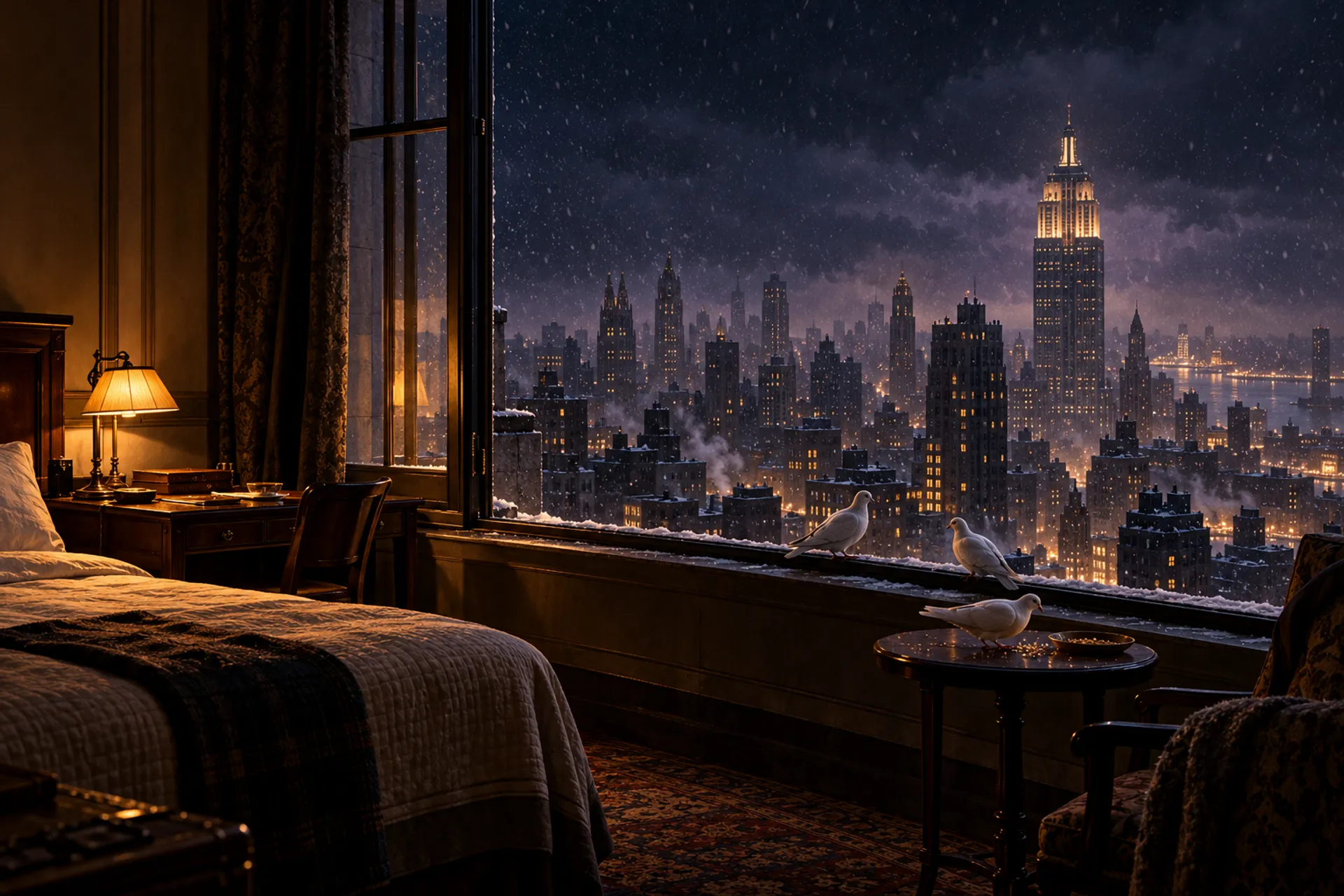
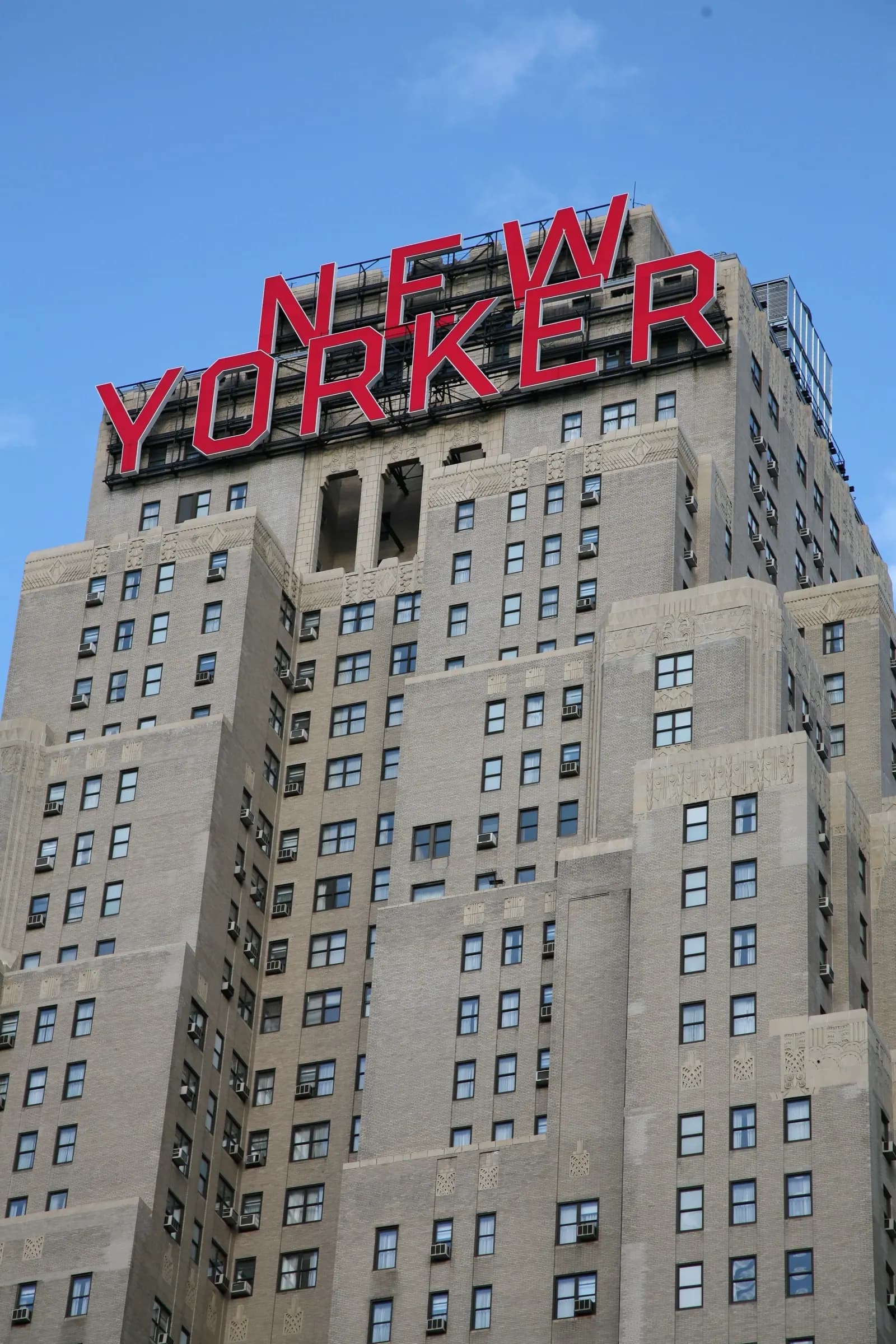
From 1900 on he lived in hotels: the Waldorf-Astoria, the St. Regis, the Pennsylvania, the Governor Clinton. In 1934 he settled at the Hotel New Yorker on Eighth Avenue, in room 3327 on the 33rd floor. According to Carlson, in those last years Westinghouse paid his rent.
In 1931, for his 75th birthday, he had been on the cover of Time.
Chapter 17
1943New York · 1943
The seventh of January
He died alone on 7 January 1943, in room 3327, aged 86. The coroner gave coronary thrombosis. A maid found him the next morning.
The Office of Alien Property seized his papers, and the MIT engineer John G. Trump went through them. The funeral was held on 12 January at the Cathedral of St. John the Divine in New York, and he was cremated at Ferncliff Cemetery.
Five months later, on 21 June, the US Supreme Court struck down Marconi's main tuning patent, in part because Tesla's patent US 645,576 had anticipated it. The Court did not name anyone the inventor of radio. It settled a patent dispute.
Chapter 18
1957Belgrade · 1957
The golden sphere
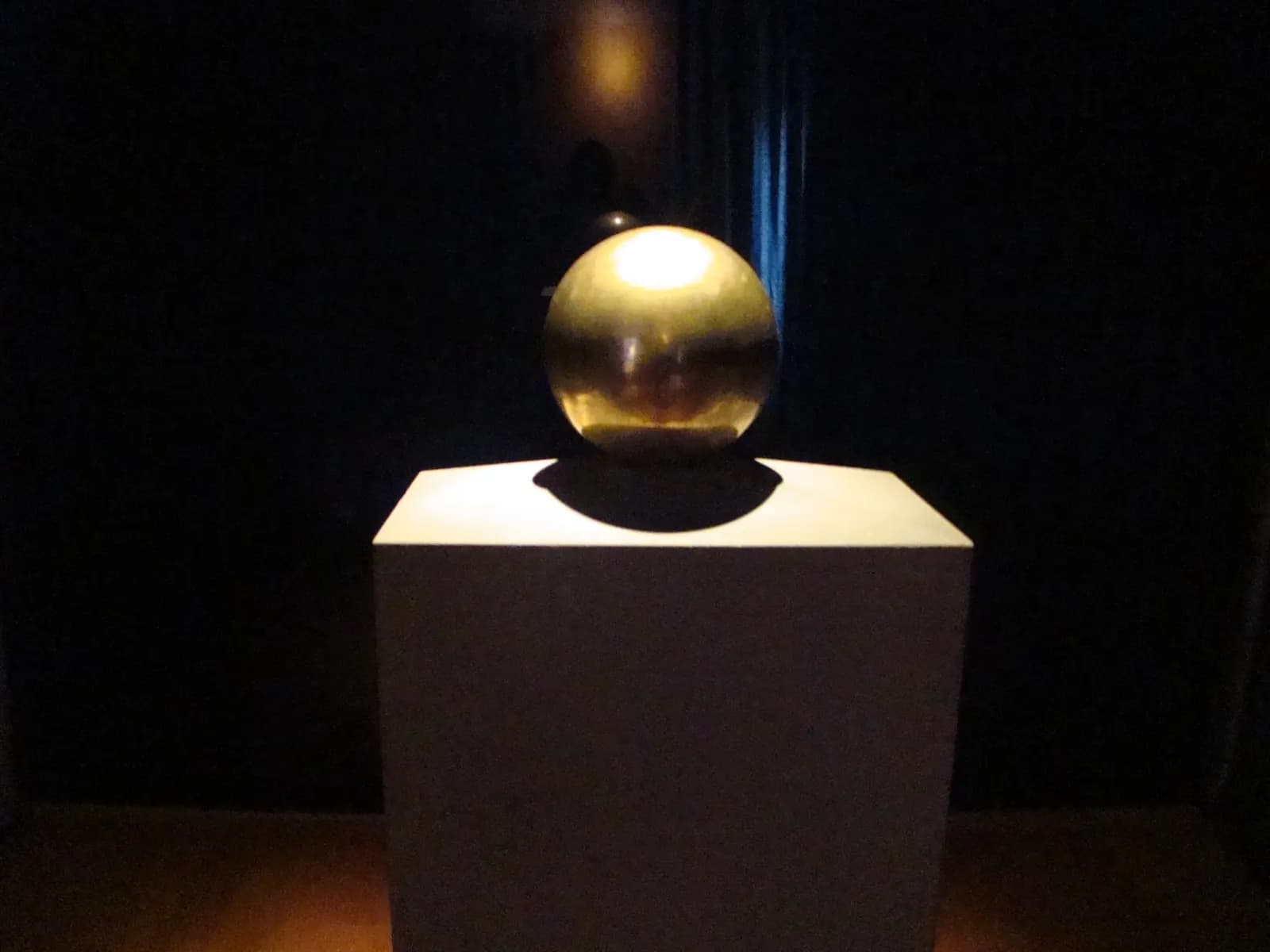
In 1957 his nephew Sava Kosanović brought the urn to Belgrade. It has rested ever since at the Nikola Tesla Museum, 51 Krunska Street, inside a golden sphere. The Yugoslav government founded the museum in 1952 and it opened in 1955; it keeps his personal archive, more than 160,000 documents, on UNESCO's Memory of the World register since 2003.
In 2014 the Serbian Orthodox Church asked for the urn to be moved to the Church of Saint Sava. As we finished this tribute, we could not confirm where that request stands.
Chapter 19
1960Paris and Zagreb · 1960
The tesla
In 1960 the 11th General Conference on Weights and Measures, meeting in Paris, adopted the tesla (T) as the SI unit of magnetic flux density: one tesla is one weber per square metre. His name became part of physics.
He left some 300 patents in 26 countries, 112 of them in the United States.
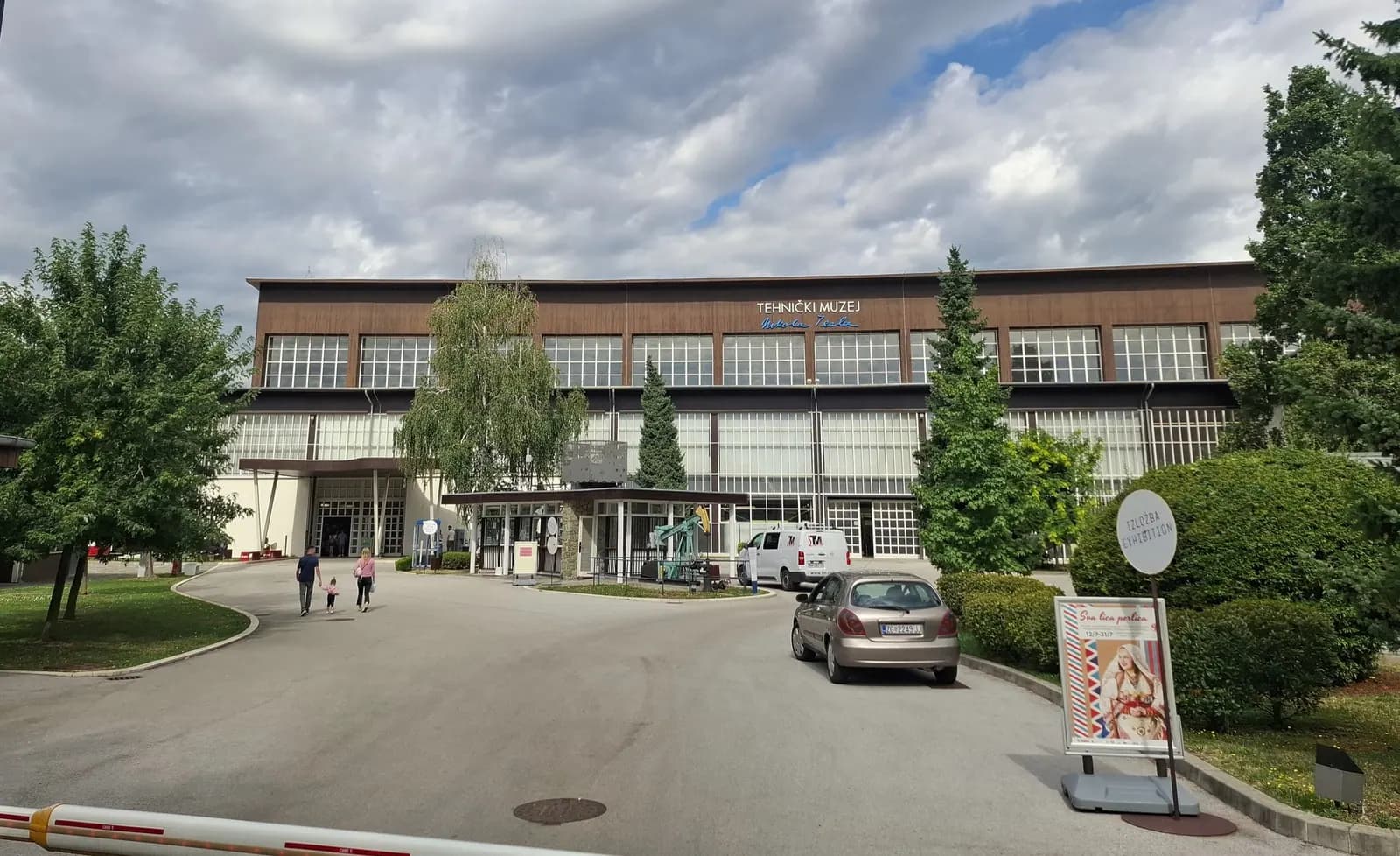
In Zagreb, the Technical Museum opened in 1963, twenty years after his death, with experiments on his transformer. In 2015 the city gave it his name: the Nikola Tesla Technical Museum. It is the museum this tribute walks you through.
The journey
The places of his life
Smiljan, Graz, Budapest, Paris, New York, Colorado Springs, Belgrade: the map of his life, on the globe.
The sources
Every fact on this page comes from these sources. Where all we have is Tesla's own word, we say so.
- Nikola Tesla, «My Inventions», Electrical Experimenter, 1919.
- W. Bernard Carlson, Tesla: Inventor of the Electrical Age, Princeton University Press, 2013.
- Marc J. Seifer, Wizard: The Life and Times of Nikola Tesla, Citadel, 1996.
- Muzej Nikole Tesle, Beograd (tesla-museum.org).
- Tehnički muzej Nikola Tesla, Zagreb (tmnt.hr).
- Google Patents / USPTO.
- Marconi Wireless Telegraph Co. of America v. United States, 320 U.S. 1 (1943).
- BIPM, 11e CGPM (1960).